Showing posts with label new guinea. Show all posts

Thursday, June 11, 2015

Dendrobium agathodaemonis

Dendrobium agathodaemonis is usually considered a synonym of Dendrobium cuthbertsonii and comparing this post with the previous will certainly show why.  If there are any reason to consider them separate species then the lack of dark markings on the lip and the very thin growths distinguish this species.  The growth on my plant are 1 cm tall and produce 3 cm flowers.  My plant is grown on a piece of cedar and the flowers are pendant.


Dendrobium cuthbertsonii bicolor

This is one of a number of bicolor Dendrobium cuthbertsonii I own, and this is one of the better examples, with very large and very open flowers.  Like other examples of this species the plant itself is tiny, only 2 cm tall, with 4 cm flowers.  Some of the plants of this species I grow mounted.  This is grown in a clay pot in live sphagnum, but does no better than those that are mounted.


Wednesday, April 15, 2015

Dendrobium limpidum 'Ashley'

Dendrobium limpidum is from New Guinea and belongs to the Pedilonum section of Dendrobium.  This group of Dendrobiums have arching or pendant canes and most of them are quite large.  This plant is one of the smallest in the group.  It is considered by some to be the same plant as Dendrobium dichaeoides and  the plants do resemble another orchid genus named Dichaea with their closely set alternating leaves.  The canes are about 10 cm in length and produce clusters of rather small flowers that impress more by their bright color and number than by their individual beauty.  The flowers are less than 2 cm but come in clusters of around 15 flowers.  Like the other flowers in the Pedilonum section the flowers tend to be more or less tubular.  In this case the flowers are not only tubular but do not open very far and have a lip that curls up to block most of the open end of the flowers.  This can be seen in the close-up photos.  One very nice thing about this species is that the older canes continue to produce flowers for several years, though the new canes do not bloom the first year.  The older canes eventually lose their leaves but will even then continue to produce flowers.  On another note: I took this plant in for judging a few days after I posted this and it received a cultural award (Certificate of Cultural Merit) from the American Orchid Society.


Wednesday, February 11, 2015

Mediocalcar versteegii 'Mountainside'

I've seen this species under two names and am not sure which is correct.  I purchased it as Mediocalcar versteegii, but have also seen it under the name Mediocalcar uniflorum.  In either case it is from New Guinea and is a rambling plant, each new growth coming from the top of the previous growth.  It blooms late winter to early spring and the flowers are not long-lasting.  I have my plant in a pot, but most of it is not in the pot and doesn't need to be.


Thursday, January 15, 2015

Dendrobium cyancocentrum

This is another tiny species from New Guinea, but it belongs to a different section than most of the New Guinea Dendrobiums I post.  This jewel is from section Calyptrochilus.  The plant is only 4 cm tall and the flowers are 1.5 cm.  There is a blue-flowered form of this species as well, but both have the blue "column" that gives the species its name.  I am flowering this for the first time and it has only a single flower, but I thought I'd post it anyway.


Friday, January 9, 2015

Dendrobium petiolatum

Dendrobium petiolatum is another species from the Oxyglossum section of that genus, one of my favorite groups of orchids.  It is one of the larger species in that section, though still small, and the flowers have all the characteristics of that section.  They are colorful, with a lip that is differently colored and accents the flowers beautifully.  The plant with its round pseudobulbs is 9 cm tall and the flowers, which come in clusters from the top of the older leafless pseudobulbs, are 2 cm.  The species is from New Guinea and this is the first time I've grown and bloomed it.


Note: Kevin, if you see this, I need your address.  I changed email servers and cannot find your address anywhere.  You can contact me at ronaldhhanko @ outlook.com (without the spaces).

Monday, December 15, 2014

Dendrobium alaticaulinum

Dendrobium alaticaulinum is a New Guinea Dendrobium from the Pedilonum section of that genus.  Most of the New Guinea Dendrobiums I grow are from the Oxyglossum section.  The Pedilonum Dendrobiums tend to be large plants with long semi-pendant canes, but this species is very small in comparison, the canes around 15 cm.  The 2 cm flowers bloom at the end of the canes in clusters and do not open very widely.  The plant is not a very eager bloomer for me, but since I reduced the light a bit it has bloomed a bit more freely.


Friday, December 5, 2014

Mediocalcar decoratum

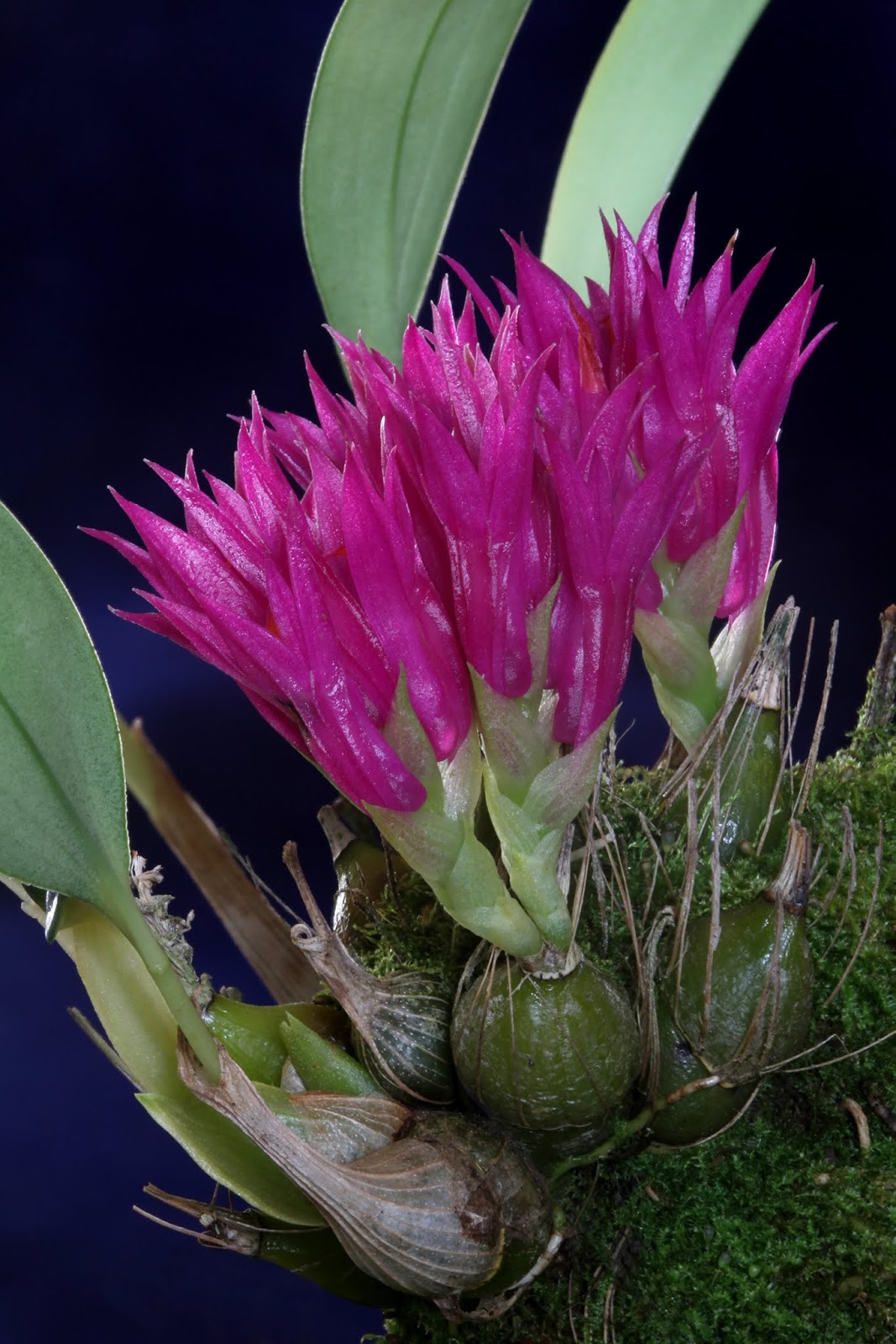
One of my favorite miniature orchids, this plant produces hundreds of flowers in autumn.  The individual growths are less than 2 cm, each a fat little stem with three of four propeller-like leaves.  They grow from the top of the previous stem, however and ramble all over producing a mat of growths that soon covers a mount or spills over the edges of a pot.  The tiny, less than 1 cm, orange and yellow flowers are colored like candy corns and look like a little balloon that has exploded on one end.  The species is from Papua New Guinea and prefers cool temperatures and high humidity with good light.


Tuesday, November 25, 2014

Dendrobium agathodaemonis

Dendrobium agathodaemonis is considered by some to be a synonym of Dendrobium cuthbertsonii.  To me, however, there are obvious differences, though they may not warrant species status.  Even though the flowers are of the same shape and size as Dendrobium cuthbertsonii, they lack the dark markings on the lip and have growths that are much thinner.  Both of these features are obvious in the following photos.  Like its near relative it is a prolific bloomer when grown well and has flowers that last many months.