Showing posts with label porroglossum. Show all posts
Thursday, March 19, 2015
Porroglossum meridionale
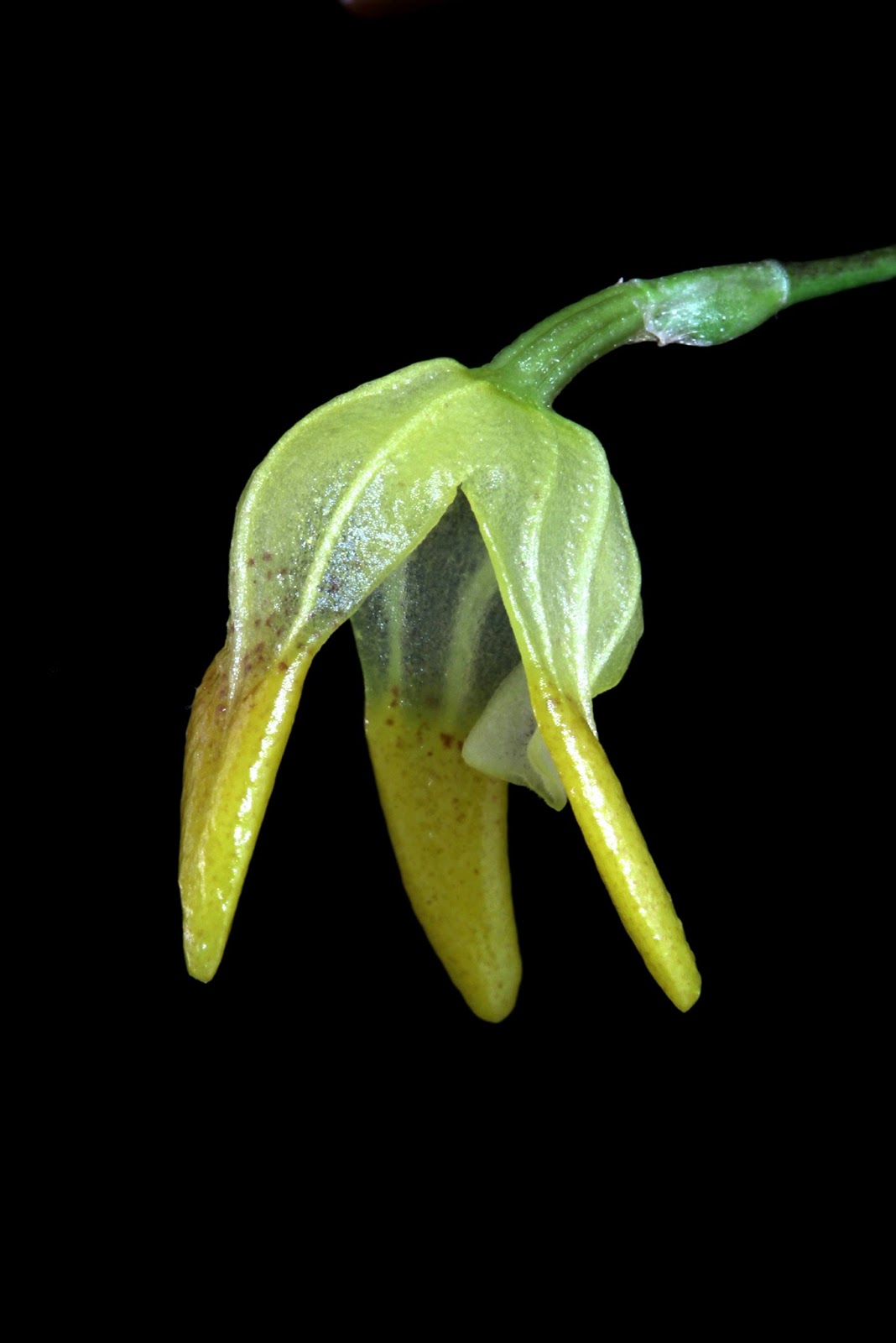
It seems to be Porroglossum season. Almost all of mine are in bloom at the moment. Porroglossum meridionale is another species from this genus of insect-trapping flowers. The flowers have hinged lips and when disturbed by a small insect the lip suddenly snaps up trapping the insect against the column, effecting pollination. Most of the pictures show the lip open but the close-up photo shows it shut against the column. The plant is 6 cm tall, the flower spikes 10 cm in length, and the flowers 1.5 cm. It hails from Peru.
Labels:
orchid,
peru,
pleurothallid,
porroglossum,
porroglossum meridionale
Saturday, February 28, 2015
Porroglossum rodrigoi
The Porroglossums are all miniature plants and all have an insect-trapping lip that springs up and mashes the insect against the column when the insect visits the flower, thus effecting pollination. Two of the photos show the flower with the lip open and closed. Porroglossum rodrigoi is a micro-miniature species from Colombia with beautifully patterned 3 cm leaves, 9 cm flower spikes that produce a few 1.5 cm flowers in succession. The species is name for a Colombian orchid collector and requires cool temperatures to trive. My plant is grown on a small piece of cedar shingle with some moss.
Labels:
colombia,
orchid,
pleurothallid,
porroglossum,
porroglossum rodrigoi
Saturday, April 19, 2014
Porroglossum driesei
The Porroglossums are a strange groups of orchids. They all have hinged, insect trapping lips and two of the pictures below show this species with the lip open and closed. Porroglossum dreisei is from Ecuador and blooms repeatedly on the same flower spikes, so that it is seldom out of bloom. The plant is 4 cm tall, the flower spikes are 12 cm long and the flowers 1.5 cm, oddly shaped and oddly colored.
Labels:
ecuador,
orchid,
pleurothallid,
porroglossum,
porroglossum dreisei
Tuesday, February 25, 2014
Porroglossum tripollex
Porroglossum is a genus of miniature orchids all of which have spring-loaded moveable, insect-trapping lips. When the flower is disturbed by a visiting insect, the lip springs up trapping the insect against the column and hopefully effecting pollination. The genus is related to Masdevallia and includes about 50 species.
This small plant is Porroglossum tripollex from Ecuador. I have two of these, one with brown "tails" and this with yellow. The flower looks to me like a bird's beak, but tripollex means "three thumbs," a resemblance I do not see. It is cool to cold growing and comes from montane forests.
In these photos the flowers all have their insect-trapping lips in the open position, except for several flower in the picture of the plant and the upper flower in the largest picture. The plant is difficult to photograph with the lips open because the slightest disturbance cause the lips to snap shot.
Labels:
ecuador,
orchid,
pleurothallid,
porroglossum,
porroglossum tripollex
Wednesday, May 1, 2013
Porroglossum meridionale
Porroglossum meridionale is another species from a genus of insect-trapping flowers with hinged lips. When disturbed by a small insect the lip suddenly snaps up trapping the insect against the column and effecting pollination. I've provided pictures of the flowers with the lip in both positions. This plant is 6 cm tall, the flower spikes 10 cm in length, and the flowers 1.5 cm.
Labels:
orchid,
peru,
pleurothallid,
porroglossum,
porroglossum meridionale
Saturday, April 6, 2013
Porroglossum dreisei
The last post was of a Porroglossum. Here is another, this time Porroglossum dreisei from Ecuador and another small species. The plant is 4 cm, the flower spikes 12 cm and the flowers 1.5 cm and blooming successively, several to a spike. Like the other Porroglossum species this has a moveable lip that snaps up and traps an insect against the column effecting pollination and I've included pictures of the flowers with the lip both open and shot. I thought about titling the post "Arms Akimbo" since the flowers look like a little man with an elf hat and his hands on his hips.
Labels:
ecuador,
orchid,
pleurothallid,
porroglossum,
porroglossum dreisei
Tuesday, April 2, 2013
Porroglossum tripollex
Porroglossum tripollex belongs to a genus of plants closely related to Masdevallia, but all having a moveable, insect-trapping lip. They are usually small plants with rather long flower spikes that hold the small flowers well away from the plant. When the lip is disturbed it eventually snaps up against the column of the flower trapping some tiny insect against the column and effecting pollination. This species is from Ecuador, is 3 cm tall and has 1.5 cm flowers on 6-8 cm flower spikes. The first three of the following photos show the flower with the lip "unsprung." The last two photos shows the flower with the lip "sprung."
Labels:
ecuador,
orchid,
pleurothallid,
porroglossum,
porroglossum tripollex
Wednesday, May 2, 2012
Porroglossum hirtzii
I am so far behind with posts that this is now finished blooming. I had hoped to get a picture of the plant in bloom and missed that as well. The species is from Ecuador as the name would suggest (Alexander Hirtz was a well known German orchid collector in Ecuador in the late 1900's). The plant is 4 cm tall and the leaves are a dark green with a lightly pebbled surface. The flowers spikes bear only one flower and are 10 cm long and tend to be pendant. The flowers are 1.5 cm long and have the typical hinged lip of this genus, a lip that swings up when the flower is disturbed by a pollinating insect, trapping the insect against the column of the flower.
I found this a rather frustrating plant. Most of the flower spikes aborted again this year even though the plant is well established, and the flowers that did open were very difficult to photograph. As soon as the plant is moved the lip to swings up and takes forever to come down again and I wanted pictures of the flowers with the lip in both positions. I grow the plant on a block of tree fern so that the spikes have space to grow downward and keep it in quite low light. It is watered frequently and as with all my orchid receives just trace amounts of fertilizer (a pinch in two gallons of water every two out of three waterings). The first three photos show the lip "down" and the last photo shows it "up."
Labels:
ecuador,
orchid,
pleurothallid,
porroglossum,
porroglossum hirtzii
Wednesday, April 11, 2012
Porroglossum meridionale
Porroglossum meridionale is a miniature species from Peru that belongs to the Pleurothallids, looks like a tiny Masdevallia, and was, in fact, once classified as a Masdevallia. The Porroglossums are distinct, however, in having a hinged and moveable lip that swings up against the column when the flower is visited by a pollinating insect or bumped by a curious onlooker. The plant is 6 cm tall, the flower spikes 10 cm in length and the flowers 1.5 cm. The flowers are nearly translucent.
flower with the lip flipped up against the column
Labels:
orchid,
peru,
pleurothallid,
porroglossum,
porroglossum meridionale
Sunday, August 15, 2010
Porroglossum teaguei
In bloom now and almost always in bloom is another miniature orchid, Porroglossum teaguei. This small plant is another in the Pleurothallid group of orchids, a group of mostly smaller species from Central and South America, many of them from high altitudes.
Porroglossum teaguei, described for the first time in 1980, is from Ecuador and is named after Walter Teague, its discoverer. The plant is about 4 inches tall and the flowers about 1.5 inches, blooming successively on 7 inch inflorescences. The flowers are translucent and have very long "tails."
The Porroglossums are very interesting for their mobile lip, which is on a kind of hinge and swings up when touched, trapping small insects against the column and thus pollinating the flowers. The mechanism seems to work repeatedly as long as the flower is not pollinated and the lip, after springing up stays in that position from a few minutes to an hour.
The following photos show: (1) a close-up of the flower; (2) the flower with the lip in the ordinary position; (3) a flower with the lip "sprung;"; and (4) a single flower with the plant in the background (this flower happened to open upside down, but this has no effect on the mechanism that springs the lip).
Labels:
ecuador,
orchid,
pleurothallid,
porroglossum,
porroglossum teaguei
Subscribe to:
Posts (Atom)