Friday, February 1, 2013
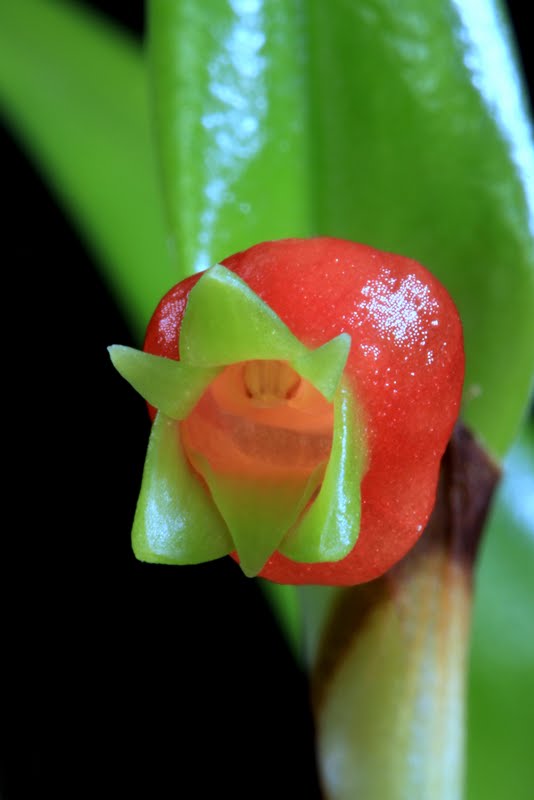
Mediocalcar decoratum 'Jannetje'
I posted another species from this genus recently, Mediocalcar versteegii. Like that species this is from New Guinea and a rambler. Each growth grows on top of the previous growths and the plant, as a result, forms a dense mat of growths. This plant, however, is much small, each growth only 2 cm tall, and thus it is much easier to contain and can even be grown in a pot as mine is, though the roots do not stay in a pot. The growths are little cylindrical pseudobulbs with three or four fat little leaves at the top of each like a little propeller and with flowers look like little candies. The plant was given both a Certificate of Botanical Recognition and a Certificate of Cultural Merit by the American Orchid Society many years ago. It prefers cool temperatures and good humidity but is easy to grow.
Labels:
mediocalcar,
mediocalcar decoratum,
new guinea,
orchid
Saturday, January 26, 2013
Masdevallia sotoana 'Edward' CBR/AOS
This tiny Masdevallia is from Ecuador and belongs to the Saltarices group, a group that contains many of my favorite Masdevallia species. The flowers on this species are 1.5 cm long and have a spread (measured across the front of the flower) of only 2 cm. The plant is 4 cm tall and was awarded recently by the American Orchid Society at the Pacific Northwest Regional Judging in Seattle. It was given a Certificate of Botanical Recognition (CBR/AOS) and had 20 flowers and 10 buds when awarded. The description was: "sepals white, translucent; brilliant orange stripes inside sepaline tube; white hispid hairs; caudae yellow; petals and lip white; substance firm; texture sparkling; lip and petals too small to measure; light woodsy fragrance."
Labels:
cbr/aos,
ecuador,
masdevallia,
masdevallia sotoana,
orchid,
pleurothallid,
saltatrices
Monday, January 21, 2013
Masdevallia hirtzii
Masdevallia hirtzii with its a colorful and abundant flowers always provides a a bit of color in the middle of the winter. It always produces its flowers for me from November to January and though the individual flowers only last a few weeks, it continues to produce them over that three month period, but then is done blooming for the year, too. It belongs to the Saltatrices group and the characteristics of this group are evident in the photos, tubular flowers and a "belly' at the base of the flower tube.
Labels:
ecuador,
masdevallia,
masdevallia hirtzii,
orchid,
pleurothallid
Wednesday, January 16, 2013
Mediocalcar versteegii 'Mountainside'
The small genus, Mediocalcar, includes around 20 species, all of which are from New Guinea and most of which are high-altitude, cloud-forest plants. The flowers come in unusual and bright color combinations, as is the case here. This species has individual growths of 5-9 cm, an elongated pseudobulb with a single leaf, both equal in length. The growths grow on top of each other, however, and form a rambling tangled mass. The plant shown here is 20 cm tall, but tied up with a piece of monofilament to keep it from going all over. The flowers are 1 cm and often have a drop of water inside, whether from watering or condensation I do not know. The plant flowers for me during the winter and always puts on a good show.
Labels:
mediocalcar,
mediocalcar versteegii,
new guinea,
orchid
Saturday, January 12, 2013
Reichantha striatella
Reichantha or Masdevallia striatella is an attractive and prolific species from Ecuador. It is distinguished by its bold stripes which are rather rather rare among Masdevallias. The plant is 8 cm tall and the flowers are 1.5 cm long. It blooms early in the winter and I grow it, like most of my Masdevallias, in a plastic net pot in live sphagnum moss.
Labels:
ecuador,
masdevallia,
orchid,
pleurothallid,
reichantha,
reichantha striatella
Tuesday, January 8, 2013
Tubecentron Niu Girl
Tubecentron Niu Girl is a hybrid of Tuberolabium kotoense and Ceratocentron fesselii, the latter a very attractive but somewhat hard-to-grow miniature. I have two plants of this hybrid and they are both about the same size but one has flowers that are more red than the other, as seen below. The plant is small, like a tiny, few-leaved Vanda, 10 cm across, with a cluster of flowers each around 1.5 cm in size. Both plants bloomed for me for the first time this past autumn, one with 8 flowers, the other with 4. They are sparkling in texture and have an unusual pinkish pouched lip with a long spur behind the pouch. It is mounted on cork that has a layer of moss growing on it and seems to prefer cool temperatures like the Caeratocentron parent.
Plant #1
Thursday, January 3, 2013
Dendrobium Gina Perlite
Dendrobium Gina Perlite is a hybrid of two small Oxyglossum Dendrobiums from New Guinea, Dendrobium prasinum and Dendrobium cuthbertsonii. This particular clone has the name "Crystal White" and has very large flowers for the plant, 4 cm long) but flowers that are by no means crystal white. They are a very pale yellow (the photos reproduce the color accurately). The plant is larger than Dendrobium cuthbertsonii, 4-5 cm in height. It is growing at present in a small clay pot in sphagnum moss.
Subscribe to:
Posts (Atom)